For most of us, the garage is the catch-all of the house. It’s where we park the cars, stack the holiday decorations, store the lawnmower, and maybe—if we are ambitious—set up a small workbench or a squat rack. It is a utilitarian space, often unfinished and unloved.
It is also usually the most uncomfortable room in the entire house. In the summer, the garage becomes a kiln. The sun beats down on the driveway, the heat radiates through the door, and the air becomes stagnant and suffocating. In the winter, it’s an icebox. Because of this extreme temperature fluctuation, we treat the garage as a space to run through, not a space to be in.
But it doesn’t have to be this way. Homeowners are increasingly reclaiming this square footage, transforming garages into active workshops, home gyms, or man caves. The secret to making this transition work isn’t just adding insulation or a portable heater; it’s managing the light. Installing high-performance solar shades—whether on the windows or as large, motorized screens over the main opening—can fundamentally change the physics of the room.
If you have given up on your garage because it’s too hot, too bright, or too exposed to the neighbors, here is why shading this space is one of the most practical upgrades you can make.
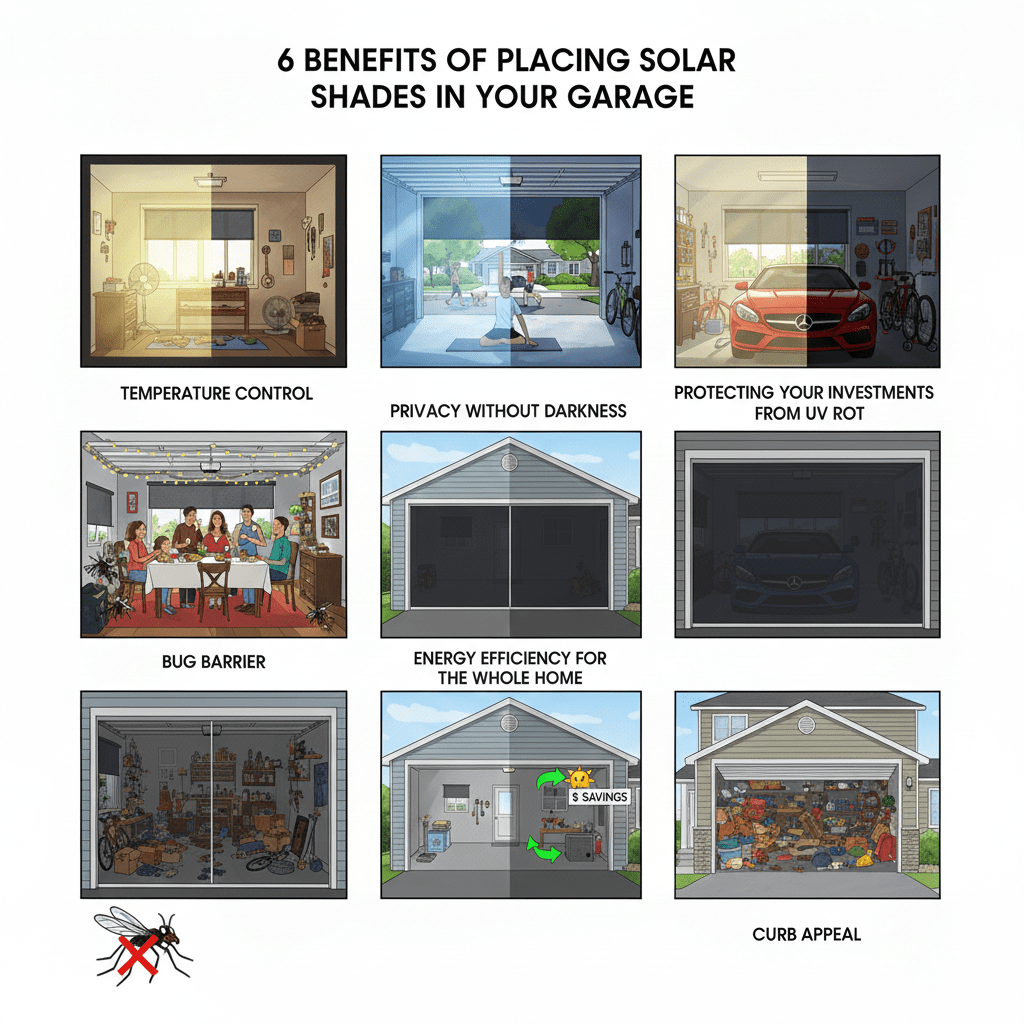
1. Temperature Control
The primary reason garages get so hot is solar gain. When sunlight hits the glass of your garage windows (or pours into the open bay door), it heats up the concrete floor and the objects inside. That heat gets trapped, and because garages are rarely connected to the home’s central AC, there is nowhere for it to go.
Solar shades act as a thermal shield.
- The Physics: unlike standard blinds that just block the view, solar shades are designed to absorb and reflect UV rays before they turn into heat.
- The Result: By installing exterior solar shades on garage windows, you stop the sun from heating up the glass. If you install a large drop-down screen over the main garage opening, you can leave the heavy insulated door up to allow airflow while still blocking the intense heat of the sun. This can lower the ambient temperature in the garage by 10 to 15 degrees, turning a stifling sweatbox into a usable workspace.
2. Privacy Without Darkness
We’ve all faced the open door dilemma. You are working on a project, waxing the car, or doing a workout in the garage. You want the fresh air, so you open the big garage door.
Suddenly, you are on display for the entire neighborhood. Every person walking their dog looks in. You feel exposed, so you close the door and suffer in the heat.
Solar shades solve this instantly. The weave of a solar fabric is magical. It is designed to be one-way visible during the day. From the inside, looking out, you can see the driveway, the street, and the trees. You don’t feel closed in. But from the outside, looking in, the screen appears opaque. It cuts the glare and blocks the view. You get the breeze and the view of the outdoors, but your neighbors can’t see what kind of table saw you bought or watch you struggle through your final set of bench presses.
3. Protecting Your Investments from UV Rot
We tend to store expensive things in the garage. Cars, bicycles, kayaks, and power tools often live there.
UV rays are destructive. Over time, direct sunlight degrades plastics, fades car paint, cracks dashboard vinyl, and makes rubber tires brittle. If your garage has windows that let in unfiltered morning or afternoon sun, anything sitting in that beam of light is slowly cooking.
Solar shades block up to 99% of harmful UV rays while still letting in visible light.
- The Benefit: You don’t have to work in the dark (like you would with blackout curtains). You get natural, filtered daylight to find your tools, but the destructive spectrum of the light is neutralized. This extends the lifespan of everything you store in the room.
4. The Bug Barrier
If you use your garage as a living space—perhaps as a game room or a summer dining area—the biggest enemy isn’t the sun; it’s the insects.
Leaving the garage door open invites flies, mosquitoes, and wasps to set up shop in your rafters. Many homeowners opt for motorized zipper screens (a type of heavy-duty solar shade) that descend from the header of the garage door. These screens run in a track, sealing the opening completely.
This effectively turns your garage into a screened-in porch at the touch of a button. You get the cross-breeze and the smell of fresh cut grass, but the mosquitoes stay outside where they belong.
5. Energy Efficiency for the Whole Home
Finally, we have to look at the garage as part of the house’s ecosystem. Most garages are attached, meaning they share one or two walls with your interior living space.
A hot garage acts like a giant radiator attached to your house. If your garage is 110 degrees in July, that heat transfers through the shared wall and warms up your pantry or your laundry room. Your home’s central air conditioner has to work harder to fight that heat transfer, driving up your electric bill.
By using solar shades to keep the garage cool, you create a thermal buffer zone. You reduce the load on your home’s HVAC system. It is a passive efficiency upgrade that pays dividends every month when the utility bill arrives.
6. Curb Appeal
Let’s be honest: looking into someone’s open garage isn’t usually an organized sight. It’s often cluttered with boxes, bikes, and recycling bins.
When you install a sleek, uniform solar shade or screen, you clean up the exterior visual of your home. Instead of the neighborhood seeing your clutter, they see a clean, architectural screen. It gives the home a polished, finished look, even when you are in the middle of a messy project inside.
Your garage is valuable square footage. It shouldn’t be relegated to a storage unit that you are afraid to enter. By controlling the light and the heat with solar shades, you can unlock the potential of this space, turning it into a comfortable, private, and functional extension of your home.
