You’ve held onto a bottle for fifteen years. The night arrives, you twist in the corkscrew, and the cork snaps in half or crumbles into the wine. It happens to collectors and to sommeliers. Old natural corks dry out, soften or turn brittle over time, and a standard corkscrew can tear right through them.
You can lower the odds with the right tool and a slower technique.
Prep the bottle a day ahead
Stand the bottle upright for at least 24 hours before you open it. The sediment settles and you get a cleaner pour later. Handle it gently when you move it to the table.
Cut the foil below the lip of the bottle and wipe the top of the cork and the rim with a damp cloth. Mold or dust on top of an old cork is common and doesn’t mean the wine has gone bad, but you don’t want it in your glass.
Choose the right opener
A standard waiter’s corkscrew drives a spiral into the center of the cork and pulls. On a healthy cork, that works fine. On a weak one, the spiral can bore a hole and the cork can split around it.
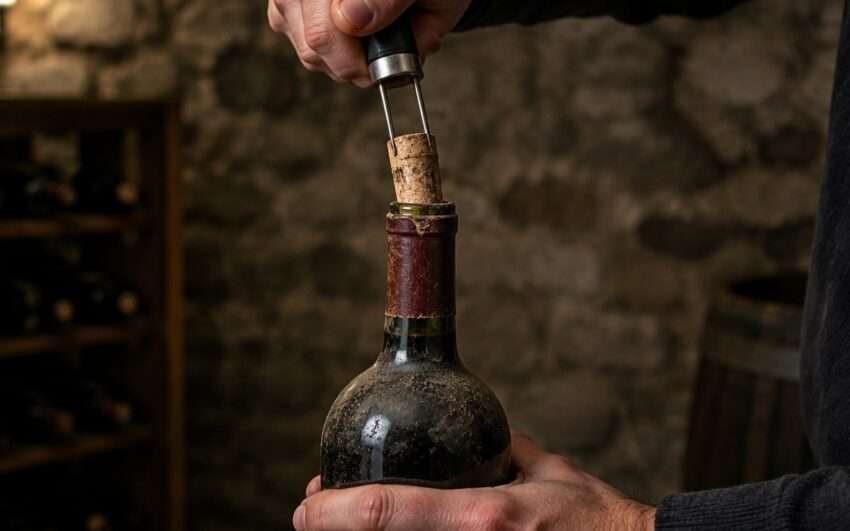
A two-prong opener, often called an Ah-So, works differently. You slide two thin metal blades down between the cork and the glass, rock them in, then twist and pull. It grips the cork from the outside, so it doesn’t punch through the middle. Many sommeliers keep one for old bottles.
Some newer openers combine the two methods: prongs on the outside and a spiral in the center, locked together so the tool supports the cork from both directions. The Wine & Spirit Education Trust points to this category as an option for fragile, aged corks.
Unhyd covered one of these tools, the Meritage dual opener from Vinotive, in a practical guide to wine serving accessories. The piece is honest about the limits: no opener guarantees an intact cork, and technique still matters. It also explains how to match an opener, a decanter or an aerator to the bottle you are serving.
Open it slowly
With an Ah-So, insert the longer prong first, then rock the tool side to side as you push both prongs down until the handle sits on the cork. Twist while pulling up in small steps. Don’t yank.
With a spiral opener, insert it at a slight angle and stop before the tip pierces the bottom of the cork. Pull in stages and ease off if you feel the cork start to give.
If the cork breaks anyway
Stay calm. If half the cork is still in the neck, reinsert the spiral at an angle and pull the remainder. If pieces fall into the wine, decant the bottle through a fine mesh strainer, a coffee filter or clean cheesecloth. The wine itself is fine. A broken cork does not mean the wine is corked. Cork taint is a separate fault, and you will know it by a musty, wet-cardboard smell.
Serve it gently
Old wines can be fragile. Decant slowly to leave the sediment behind, taste right away, and serve within the hour. Some aged wines fade fast once they meet air. Skip aggressive aeration. Your job is to protect what fifteen years in the bottle created.
Store your next bottles right
Keep bottles with natural corks on their side in a cool, dark place with a steady temperature and some humidity. The corks stay moist, and your next opening goes easier.
An old bottle deserves a little extra care. Prep it, choose an opener that supports the cork, and take your time.
