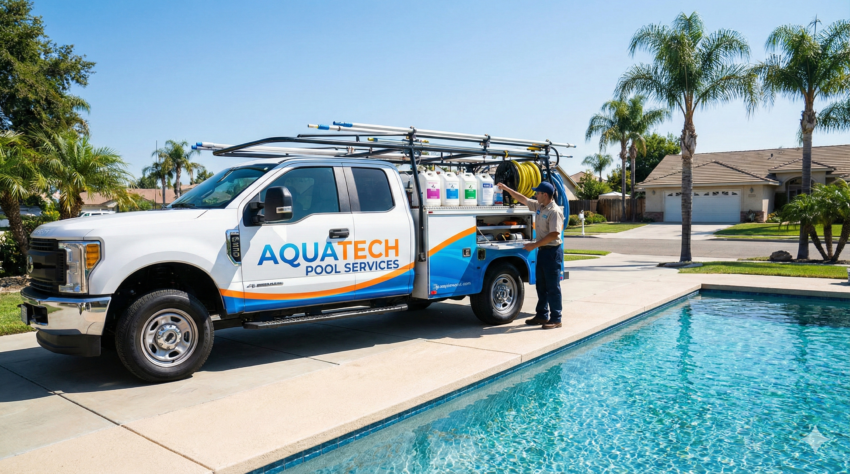
Your truck is more than just a way to get from point A to point B; it is your mobile warehouse, your chemical storage facility, and your primary billboard. For a pool service professional, the vehicle you drive dictates your efficiency, your safety, and ultimately, your bottom line.
Choosing the right rig is one of the first and most critical decisions you will make when launching or expanding your route. You aren’t just buying a daily driver; you are investing in a piece of industrial equipment. Whether you are an independent contractor or looking into a pool franchise opportunity, selecting the right set of wheels requires balancing payload, safety, and operational costs.
Here is a guide to navigating the lot and finding the workhorse that fits your business needs.
1. The Great Debate: Pickup Truck vs. Cargo Van
The most common dilemma in the pool industry is choosing between an open-bed pickup and an enclosed cargo van. Both have loyal followings, but the decision usually comes down to one factor: chemistry.
The Case for Pickup Trucks: For many pool pros, the pickup truck is the undisputed king. The primary reason is ventilation. Pool chemicals, particularly muriatic acid and liquid chlorine, emit corrosive fumes. In an enclosed van, these fumes can oxidize metal tools, destroy electrical wiring, and create a hazardous breathing environment for the driver.
- Pros: Excellent ventilation for chemicals, easy access to the bed from all sides, and higher payload capacities for heavy equipment repairs.
- Cons: Equipment is exposed to the elements and potential theft unless you install locking toolboxes or a bed cap.
The Case for Cargo Vans: Vans offer superior security and organization. If your route involves high-crime areas or you carry expensive electronic leak detection equipment, a locked van offers peace of mind. They also act as massive billboards, providing ample surface area for vehicle wraps and branding.
- Pros: Weatherproof storage, security for expensive tools, and a large mobile billboard for marketing.
- Cons: Requires strict chemical management. You must install sealed, vented chemical storage boxes to prevent corrosion and protect your health.
2. Payload and Weight Capacity
Pool salt comes in 40-pound bags. Liquid chlorine weighs about 10 pounds per gallon. DE powder, pumps, motors, and sand filters add up quickly. If you buy a vehicle with a weak suspension, you will burn through brakes, tires, and transmissions in record time.
You don’t necessarily need a heavy-duty dually, but you do need to calculate your worst-case scenario load.
- Half-Ton Trucks (e.g., Ford F-150, Chevy Silverado 1500): These are the standard for a reason. They can handle the weight of a full route’s chemicals plus repair equipment without sagging.
- Mid-Size Trucks (e.g., Toyota Tacoma, Nissan Frontier): These are excellent for tight urban routes where parking is a nightmare. However, be careful with payload; a full bed of salt and liquid chlorine can max out a mid-size truck’s suspension quickly.
3. Chemical Safety and Storage Setup
Before you sign the financing paperwork, visualize where the chemicals will go. This isn’t just about convenience; it is a safety requirement.
Incompatible chemicals (like acid and chlorine) must be stored separately to prevent dangerous reactions in the event of a spill.
- For Trucks: Look for a bed setup that allows you to install side-mounted toolboxes or a specialized bed rack system. This keeps chemicals low and secure while leaving the center of the bed open for bulky items like filters or heaters.
- For Vans: You will need to budget for a partition (bulkhead) to separate the cab from the cargo area. This is non-negotiable for driver safety. Additionally, look for vans with roof vents or floor vents to ensure constant airflow.
4. Fuel Efficiency and Route Density
If your route is tight—meaning you are hitting 15 pools in a single neighborhood—fuel economy might not be your top priority. But if you cover a sprawling territory with 20 minutes of highway driving between stops, a gas-guzzling V8 will eat into your profits.
Modern work vehicles have come a long way in efficiency. Many smaller transit vans and mid-size trucks now offer 4-cylinder turbo engines that provide plenty of torque for hauling while delivering decent mileage. Calculate your estimated daily mileage and compare it against the MPG ratings. Saving 5 MPG might not sound like much, but over 15,000 miles a year, it adds up to thousands of dollars in profit.
5. Professional Appearance
Finally, remember that your vehicle is likely the first thing a customer sees. A rusted-out beater might get the job done, but it doesn’t inspire confidence or justify premium service rates.
If you are joining a franchise network, there will likely be specific requirements regarding the make, model, and age of the vehicle to ensure brand consistency. If you are independent, aim for white vehicles. They hide scratches better, stay cooler in the summer sun (which helps keep chemicals stable), and provide the cleanest background for your logo and phone number.
There is no single perfect vehicle for every pool business. A repair-focused technician might need the covered security of a high-roof van, while a cleaning-focused route warrior might prefer the easy access of a mid-size pickup.
Test drive your options with your daily workflow in mind. Imagine reaching for the telepole, lifting a bucket of tabs, or loading a heavy pump. The right choice is the one that makes the hardest parts of your day just a little bit easier.
