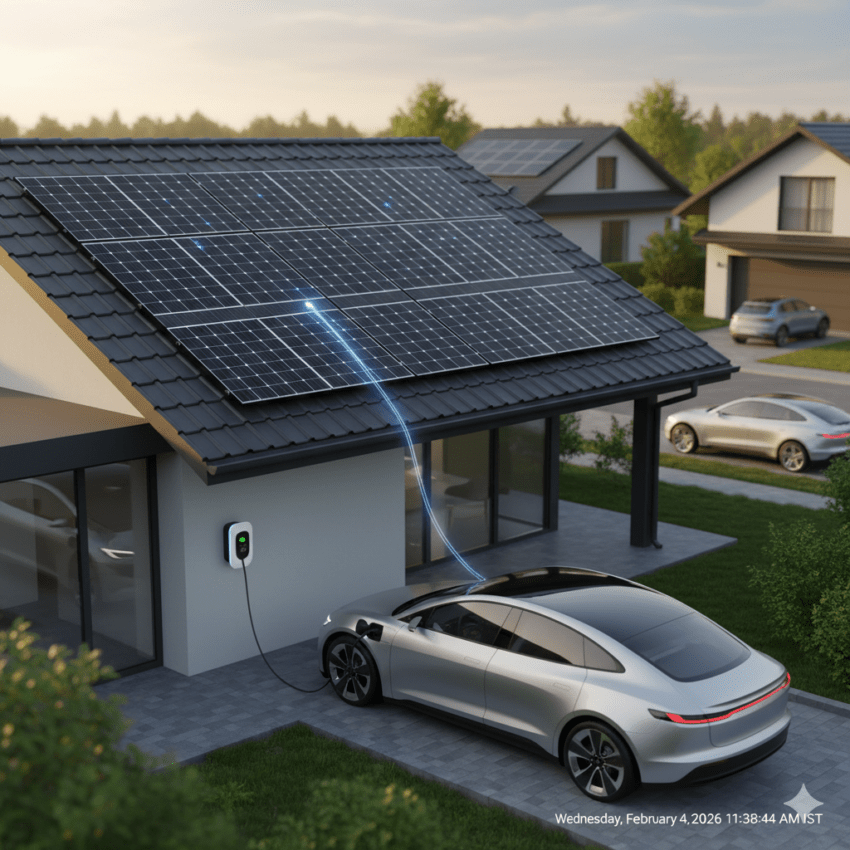
Walk down a typical suburban street ten years ago, and you saw asphalt shingle roofs and gas-guzzling SUVs in the driveway. Walk down that same street today, and the landscape has shifted. You see sleek glass arrays on the rooftops and silent, cord-tethered cars in the driveways.
At first glance, a Tesla in the garage and a solar array on the roof might seem like two different technologies. One is about transportation; the other is about utilities. But if you look under the hood (or behind the meter), they are essentially the same concept wrapped in different packages. They represent a fundamental shift in how we consume energy—moving from a model of endless monthly payments to a model of asset ownership.
It is no coincidence that people who buy electric vehicles (EVs) are often the first to install solar panel systems. They are cousin technologies that share the same DNA, the same financial logic, and the same promise of breaking free from the volatility of traditional fuel markets.
Here is a look at the striking similarities between these two green giants and why they work best when paired together.
1. The Shift from Renting to Owning Your Fuel
The biggest psychological hurdle for both solar and EVs is the sticker price. Why pay $40,000 for an EV when a gas sedan is $25,000? Why pay $20,000 for solar panels when the grid is right there? The answer lies in the difference between renting and owning.
When you drive a gas car, you are renting your miles. You pay the gas station every week, forever. If gas prices spike to $5.00 a gallon, you pay it. You have no control. Similarly, when you rely solely on the utility grid, you are renting your electricity. You are subject to rate hikes, inflation, and fees that you cannot control.
Both EVs and solar panels allow you to “pre-pay” for your energy. When you buy the equipment, you are buying 25 years of fuel upfront at a fixed price. Once the break-even point is reached, the miles you drive and the kilowatts you burn are effectively free. It is a transition from being a passive consumer to an active owner of your energy source.
2. Low Maintenance is the Secret Weapon
One of the most pleasant surprises for new EV owners is the lack of maintenance. There are no oil changes, no spark plugs, no transmission fluid, and no mufflers to rust out. An electric motor has a fraction of the moving parts of an internal combustion engine.
Solar panels share this set it and forget it DNA. A solar array has no moving parts. There are no gears to grind, no motors to burn out, and no fuel filters to clog. Aside from an occasional rinse with a hose to clear off dust or pollen, a solar system sits silently on your roof and does its job for decades.
For homeowners tired of things breaking, both technologies offer a refreshing durability. They are solid-state solutions to mechanical problems.
3. Conquering the Anxiety Myth
In the early days of EVs, everyone worried about “range anxiety”—the fear of running out of juice in the middle of nowhere. Similarly, early solar adopters suffered from “cloud anxiety”—the fear that a few overcast days would leave them reading by candlelight.
Today, both industries have matured to the point where these fears are largely obsolete.
- For EVs: Battery technology has exploded. A modern EV can easily handle 250-300 miles on a charge, covering 99% of daily driving needs without a second thought.
- For Solar: Modern panels are incredibly efficient, capturing diffuse light even on cloudy days. Furthermore, Net Metering allows the grid to act as a giant battery backup. You bank your excess summer sun to use during the winter clouds.
Both technologies have moved past the experimental phase into the reliable phase. They just work.
4. The Fill Up at Home Lifestyle
There is a specific luxury that EV owners talk about: the joy of never visiting a gas station. They plug in at night as they do with their smartphone, and they wake up every morning with a “full tank.”
Solar energy extends this convenience to the entire house. Instead of relying on a power plant fifty miles away to burn coal and send electrons down a wire to your toaster, you are generating that power twenty feet above your head.
This is where the two technologies merge into the ultimate ecosystem. If you have solar panels and an EV, you can literally drive on sunshine. You can plug your car into your house, drawing power that your roof generated for free. It closes the loop. You are no longer dependent on Big Oil or Big Utility. You have created a self-sustaining energy island on your own property.
5. Tax Incentives
Finally, the financial incentives for both technologies run parallel. The government is actively trying to push the economy toward electrification, and it is using the tax code to do it.
Just as there are federal tax credits for purchasing qualified electric vehicles, the Investment Tax Credit (ITC) offers massive savings for solar installation. These incentives are designed to lower the barrier to entry, making the ROI (Return on Investment) undeniable for the average middle-class family.
A Package Deal
It is rare to find two major purchases that complement each other so perfectly. An electric vehicle increases your home’s electricity demand, which makes the savings from a solar system even more valuable. A solar system provides the cheap, clean fuel that makes the EV even cheaper to operate.
If you are considering one, you should inevitably look at the other. They are the twin pillars of a modern, efficient, and financially savvy home. The driveway and the roof are no longer separate concerns; they are now parts of the same engine.
