We live in an era of digital exhaustion. You probably deleted five emails this morning without even opening them. You scrolled past a dozen car ads on Instagram without your thumb hesitating for a second. We have become experts at filtering out digital noise.
But when you walk out to the mailbox and pull out a stack of envelopes, the dynamic changes. You touch every single piece. You glance at every headline. Even if you toss it in the recycling bin a moment later, that physical interaction has already happened.
For automotive dealerships, this split-second of undivided attention is the most valuable currency in advertising. While every other industry has pivoted entirely to screens, the smartest general managers know that a strategic direct mail marketing campaign is often the difference between a quiet showroom and a record-breaking weekend.
Selling cars is a visceral experience—the smell of the leather, the feel of the steering wheel, the shine of the paint. It makes sense that the invitation to buy should be tactile, too. Here is why the old school method of snail mail is quietly outperforming digital channels in the automotive sector.
1- The Psychology of Mail
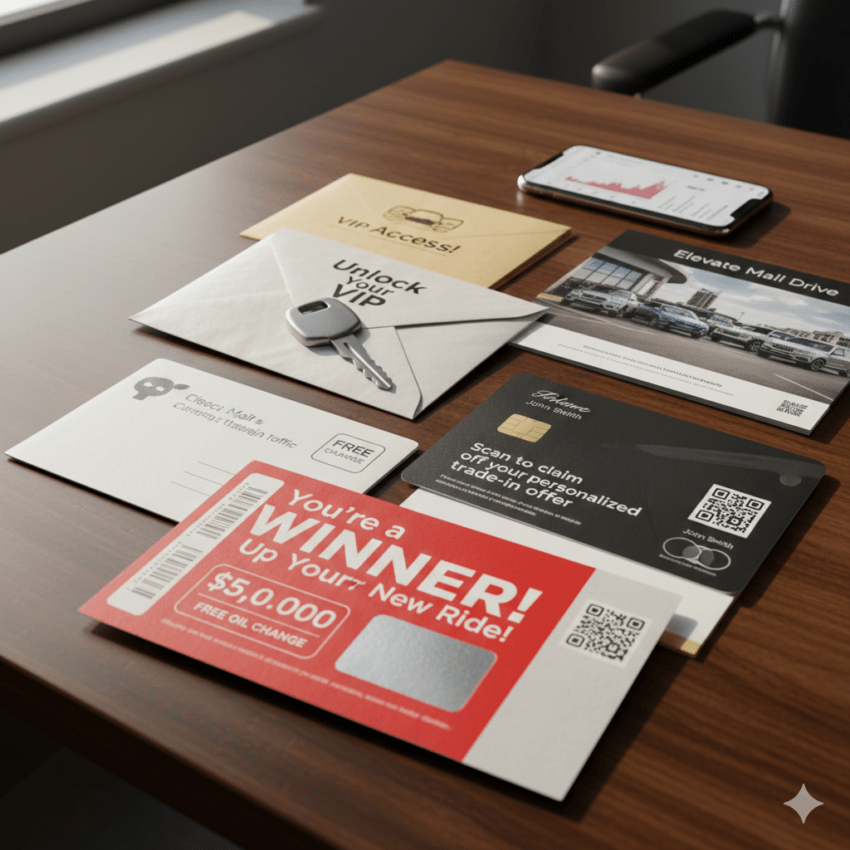
If you receive a standard white envelope, you might ignore it. But what if the envelope has a distinct shape? What if there is a fake car key inside, or a plastic card that feels like a credit card?
In the industry, this utilizes a basic psychological trigger: curiosity. Humans are hardwired to investigate objects. When a dealership sends a mailer that includes a physical object—a key that might unlock a prize vault, a scratch-off ticket, or a mock access card for a VIP event—the recipient is almost guaranteed to open it.
Once the envelope is open, the battle is half won. You have moved the customer from filtering mode to engagement mode. Compare this to an email blast. You can’t put a physical key inside an email. You can’t make a subject line have weight and texture. Direct mail allows dealerships to gamify the sales process before the customer even steps onto the lot.
2- Data: The Secret Engine Under the Hood
The misconception about direct mail is that it is sending thousands of flyers to a random zip code and hoping someone needs a truck.
That might have been true in 1995. Today, direct mail is arguably more data-driven than digital advertising. Dealerships sit on a goldmine of data in their CRM (Customer Relationship Management) systems, and direct mail is the best way to activate it.
Consider the precision available:
- Lease Expirations: You can target customers whose leases are up in 3 to 6 months with a personalized offer to upgrade early.
- Equity Mining: You can identify customers who bought a vehicle three years ago, have a high trade-in value, and a low interest rate, and send them a proposal showing them how they can keep their payment the same while driving a brand-new model.
- Service History: You can target customers who haven’t been in for service in six months with a specific “we miss you” oil change coupon.
This isn’t junk mail; it is highly relevant, personalized correspondence. When a customer receives a letter that says, “We want to buy your 2018 Ford F-150,” it feels personal because it is personal. It speaks directly to their current situation, making the offer significantly more compelling.
3- The Trust Factor
There is a growing skepticism surrounding digital ads. We have all clicked on a link that took us to a shady website, or seen a Facebook ad for a car that turned out to be sold the minute we called. The barrier to entry for digital ads is low, which means the trust level is low.
Physical mail carries a sense of legitimacy. It costs money to print and postage to send. To the consumer’s subconscious, this signals that the sender is established and serious. A high-quality, glossy brochure featuring the new lineup feels like a premium invitation. It elevates the brand.
For high-ticket items like vehicles, trust is paramount. You aren’t buying a t-shirt; you are making a massive financial commitment. A tangible piece of mail helps bridge the gap between a cold lead and a trusting relationship.
4- The Service Drive is the Backdoor to Sales
Not every piece of mail needs to scream “BUY A CAR NOW.” Some of the most effective automotive campaigns are subtle. They focus on the service lane.
Service coupons are the bread and butter of dealership retention, but they are also a stealth sales tool. A well-timed mailer offering a discount on a 30,000-mile service gets the customer onto the lot. Once they are there, waiting in the lounge, they wander into the showroom. They look at the new models. A salesperson strikes up a conversation.
Suddenly, a customer who came in for an oil change is running numbers on a trade-in.
Direct mail is the catalyst for this interaction. If that coupon had been an email, it likely would have been buried under a mountain of newsletters. On the fridge, held by a magnet, it serves as a constant reminder to visit the dealership.
5- Bridging the Gap: QR Codes and PURLs
The modern direct mail piece plays nice with technology. It doesn’t ask the customer to pick up the phone; it invites them to scan.
By integrating QR codes and PURLs (Personalized URLs), dealerships can track the effectiveness of a mail campaign in real-time.
- The Scan: A customer scans a QR code to see “How much is my car worth?”
- The Landing Page: They are taken to a custom landing page that already greets them by name.
- The Tracking: The dealership knows exactly who scanned the code, even if they don’t fill out the form immediately.
This removes the guesswork. You aren’t just wondering if the mailer worked; you are watching the traffic spike on your analytics dashboard. It combines the high engagement of physical media with the tracking capabilities of digital.
The Verdict
In a world where everyone is fighting for pixels on a screen, the smart money is moving back to the mailbox. It is less crowded, more personal, and undeniably effective.
For dealerships, the goal is to start a conversation. It is hard to start a conversation when you are just one of five hundred unread notifications. Direct mail cuts through the static. It puts your brand in their hands—literally—and in the car business, getting the customer to handle the merchandise is the first step to closing the deal
Also see:
Comfort and Convenience Can Improve Sales At a Car Dealership
