If you have ever watched a medical drama on TV, you have probably seen a scene where someone effortlessly folds a wheelchair and slides it into the backseat of a sedan in one fluid motion. It looks as easy as closing an umbrella. For anyone who has actually lived with a mobility aid, you know that scene is pure fiction.
In reality, transporting a wheelchair is a physical and logistical puzzle. Even lightweight chairs can feel ungainly and heavy when you are trying to leverage them over a bumper at an awkward angle. You are managing swinging footrests, heavy wheels, and the constant fear of scratching your car’s paint job—or worse, throwing out your lower back.
For families navigating this for the first time, the physical toll can be surprising. While there are days when calling a professional wheelchair transportation service is the best option to ensure safety and comfort, there will be plenty of times when you need to use the family vehicle.
Whether you are driving a compact sedan or a spacious SUV, there is a right way and a wrong way to handle this equipment. Here is a guide to mastering the mechanics of loading and unloading a wheelchair safely.
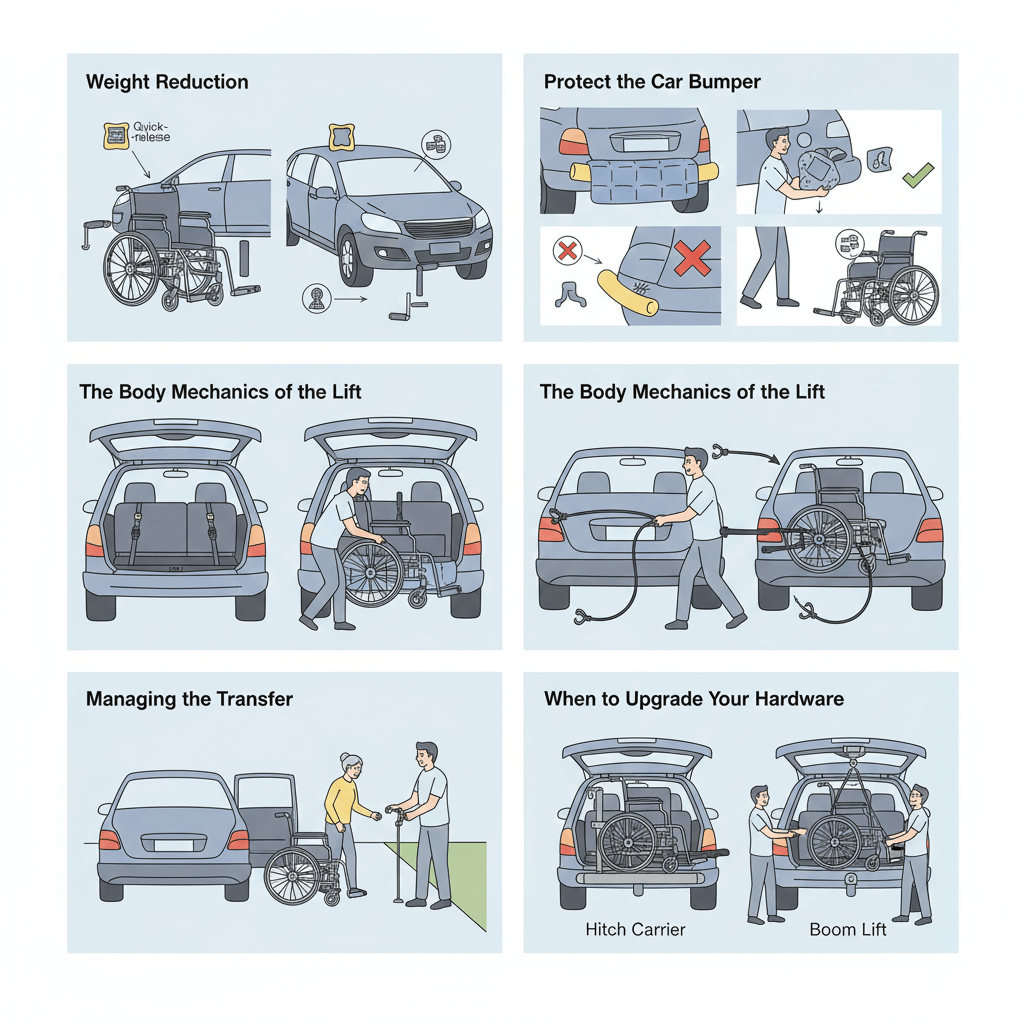
Weight Reduction
The biggest mistake people make is trying to lift the wheelchair as a single, solid unit. Most manual wheelchairs are designed to be modular, but we often forget to take advantage of this.
Before you even attempt the lift, strip the chair of its extras.
- Remove the Cushion: Gel or high-density foam cushions can add surprisingly significant weight. Throw the cushion in the backseat first.
- Detach the Leg Rests: These are the most annoying parts of the chair during a load. They swing around, hit you in the shins, and scratch the bumper. Take them off completely.
- Check for Quick-Release Wheels: Many modern chairs have a button in the center of the hub that allows the large rear wheels to pop off instantly. If you remove the wheels, the frame becomes significantly lighter and much flatter.
By spending thirty seconds disassembling the chair, you can reduce the lifting weight by 10 to 15 pounds and make the shape much less awkward to handle.
Protect the Car Bumper
If you are loading the chair into a trunk or a hatchback, your rear bumper is in the danger zone. It only takes one slip or one moment of fatigue for the metal axle of the chair to gouge the paint.
Create a buffer before you lift.
- The Moving Blanket: Keep a thick, heavy moving blanket in the trunk. Drape it over the bumper before you start loading.
- The Pool Noodle Hack: For a cheaper, permanent solution, slice a hollow pool noodle lengthwise and slip it over the lip of the trunk or the bumper. It acts as a shock absorber. If you rest the chair on the noodle while you adjust your grip, you won’t leave a mark.
The Body Mechanics of the Lift
This is where injuries happen. When you lift a wheelchair into a trunk, you are usually leaning forward, extending your arms away from your core. This is critical to avoid a spinal injury.
You need to rely on leverage, not bicep strength.
- The Grip: Grab the chair by the frame, not by the wheels (which can spin) or the armrests (which might be removable and pop off). Look for the solid metal bars of the seat frame.
- The Thigh Rest: Don’t try to lift it from the ground to the trunk in one motion. Lift the chair to your thigh first. Rest it there for a second to stabilize, adjust your grip, and then use your legs to push it the rest of the way in.
- The Slide: Once the front wheels (casters) are resting on the trunk floor (or your bumper blanket), stop lifting. Push the chair in the rest of the way. Let the car hold the weight as you slide it forward.
Securing the Cargo
Once the chair is in the car, the job isn’t done. A folded wheelchair is a heavy, metal object. In the event of a sudden stop or a collision, a loose wheelchair becomes a dangerous projectile.
If the chair is in a separate trunk, this is less of a concern. But if you are in an SUV, minivan, or hatchback where the cargo area is open to the passenger cabin, you must secure the chair.
- Bungee Cords: These are the minimum requirement. Hook the chair frame to the cargo tie-down loops found in the floor of most SUVs.
- Seatbelts: If you are transporting the chair in the backseat of a sedan, thread the car’s seatbelt through the frame of the folded wheelchair and buckle it in. Pull the belt all the way out to engage the locking mechanism (the retractor) so the chair is pinned tight against the seat back.
Managing the Transfer
We have talked about the hardware, but we can’t ignore the passenger. Transporting a wheelchair user implies that the user has to get out of the chair and into the vehicle seat.
This transfer is often more dangerous than loading the chair itself.
- Level the Surface: Try to park on flat ground. If the car is on a slope, gravity will fight you during the transfer.
- The Pivot: If the passenger has some mobility, position the wheelchair at a 45-degree angle to the open car door. Lock the brakes—double check them. Have the passenger sit on the edge of the chair, stand (or pivot), and sit backward into the car seat.
- The Car Cane: Consider buying a portable handle that hooks into the door latch of the car. It provides a solid, non-slip grab bar for the passenger to hold onto while they lower themselves into the seat.
When to Upgrade Your Hardware
If you are transporting a wheelchair daily, manual lifting might not be sustainable long-term. Even with perfect form, the repetition can lead to chronic strain.
Know when it’s time to invest in assistive devices.
- Hitch-Mounted Carriers: If you have a trailer hitch, a platform carrier is a game-changer. You simply roll the chair onto the platform, strap it down, and drive away. No lifting required.
- Boom Lifts: These are motorized arms installed inside the trunk of an SUV. You attach a hook to the wheelchair, press a button, and the machine lifts the chair and places it inside the vehicle for you.
Transporting a wheelchair requires patience and a plan. It turns a quick trip to the store into a logistical operation. But by breaking down the process—stripping the chair, protecting the car, and securing the load—you can make the experience smoother and safer for everyone involved.
However, recognize your limits. On days when the weather is bad, your back is sore, or the logistics are just too overwhelming, remember that professional help is available. Sometimes the smartest move is letting someone with a specialized van handle the heavy lifting so you can focus on being a family member, not a mover.
